A masterpiece of operational and technological logistics
Simply locating a building in the right place is not enough to attract potential tenants and investors. A well-designed center truly becomes an operational and technical…
Simply locating a building in the right place isn’t enough to attract potential tenants and investors. A well-designed center truly becomes a masterpiece of operational and technical excellence. Ewa Tomaniak, an architect at 7R, explains what truly constitutes avant-garde design and what actually poses a challenge.
The demand for warehousing is growing, partly because the way such space is used is also changing. Today’s warehouses can feature unique facades and showcase office spaces, as well as halls packed with technology and solutions that make them not only employee-friendly but also considerate of their neighbors and the planet. They can even include rooftop terraces. These are just a few examples of the features that might appeal to tenants. However, these features are driven not only by tenants’ ever-increasing demands and evolving plans, but also by innovative thinking from designers and advances in technology and expertise that open up new possibilities. This includes improvements in digitalization and warehouse design.
The key is flexibility
The design of warehouses depends on the type of space and its intended use. With a skilled designer, different types of buildings can be quickly and inexpensively converted into other types of space to meet current needs.
A designer must always think a few steps ahead when planning a functional layout and consider how it might be modified or reconfigured in the future.
as Ewa Tomaniak points out
Architect at 7R
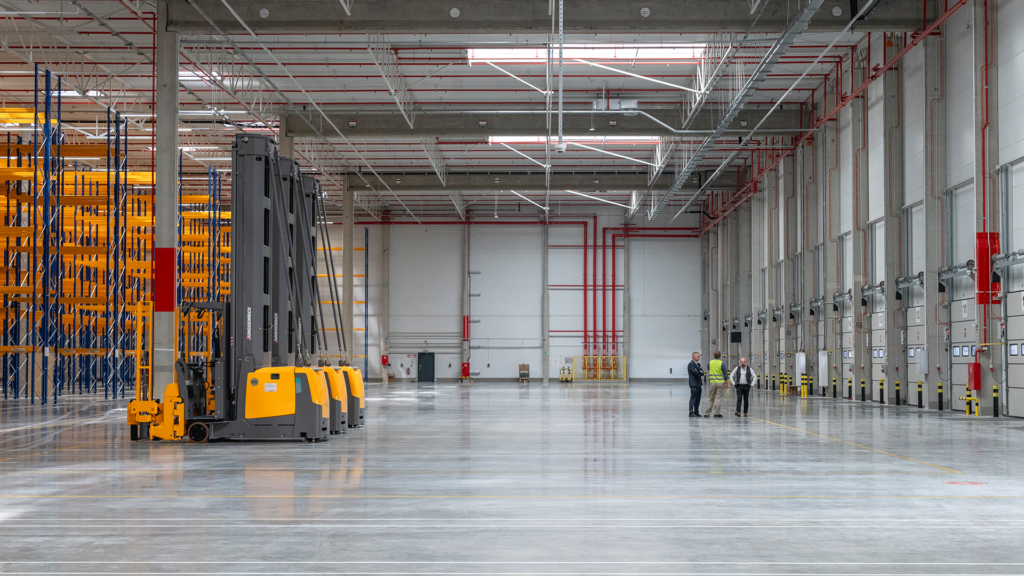
The best and most flexible ways to meet individual needs are when a client commissions a BTS (build-to-suit) or a BTO (build-to-own) project. Speculative developments are also available in what is known as the “developer standard,” a standard that is continually being refined and improved. At 7R, this means a building height of 10 m or 12 m with a floor load capacity of 7 t/sqm in logistics parks and 5 t/sqm in City Flex centers. It also includes fire safety features for buildings larger than 4,000 sqm, such as smoke extractors and sprinklers. Hydraulic docks, ground-level gates, and maneuvering areas are also included.
Urban projects, which include small business units (SBUs) with developable areas of around 10,000 square meters and city logistics facilities with developable areas of over 20,000 square meters, are very different from logistics parks, big-box developments (with developable areas of up to 50,000 square meters), and mega big-box facilities (100,000 square meters or more). Urban formats are particularly challenging.
When you’re building on an oddly shaped lot with limited space and other structures still on the site, you really have to go to great lengths to ensure that the building will ultimately be user-friendly and easily adaptable.
explains Ewa Tomaniak
And then you must listen
The need for flexible design means that alternative design methods—such as Agile—that have been tested in other business fields are beginning to be adopted in architecture and construction. With this approach, designers can easily work and collaborate with all parties involved in the development process, which is essential for understanding and meeting the client’s needs. These needs change so rapidly that active listening must be employed and questions must be asked continuously.
“The roles of the designer and the client evolve during the design phase. We gather and share information from the very beginning so that it can be put to the best possible use in later stages of development,” says Ewa Tomaniak.
The need for transparency and a multidisciplinary approach in design is evident, for example, when working with tenants that use industrial automation.
“A warehouse effectively becomes a factory, so a designer must fully understand the technology used by each branch, as well as the load-bearing requirements of each specific area and the necessary security measures,” says the 7R architect.
Technology is also helpful. The BIM (Building Information Modeling) system is gradually revolutionizing the field of design. Clients can check on progress regularly to ensure that the work continues to meet their needs and request changes early in the project.
This is like turning the traditional approach to design on its head, but as a result, not only do you save time and money, but you also reduce the use of other resources and cut down on the number of meetings required.
as Ewa Tomaniak points out
The green side of warehousing
Paying attention to sustainable development is extremely important during the design process—not only for the environment and the climate, but also from a social and economic perspective. From the very start of a project, 7R aims to obtain green certification of a sufficiently high standard, specifically BREEAM with a rating of at least “Very Good.”
“A center must be both welcoming and functional in terms of its appearance and supporting infrastructure, and this must also apply to neighboring buildings and local residents,” says Ewa Tomaniak.
This is particularly true for developments such as logistics parks, as they place high demands on local urban infrastructure. Key factors include access to roads and transportation, as well as the appropriate size of retention tanks. It is important to maintain a center’s modularity and other features that help conserve resources.
A warehouse is not just an ordinary building. It often incorporates advanced systems, modern technology, sustainable solutions, and high-quality architecture. It becomes a living organism that adapts—both inside and outside the building—to the needs of a changing world.
Ewa Tomaniak
Architect at 7R
About the author
Author's Bio
Lilianna (Elżbieta) Laudy
Marketing & Digital Manager
Lilianna Laudy serves as Digital & Marketing Manager at 7R SA, where she is responsible for developing digital and marketing initiatives that support brand visibility and online communication…