According to forecasts, the global market for green non-residential buildings is expected to grow from $69.01 billion in 2021 to $110.52 billion in 2025, at a compound annual growth rate of 9%. As…
According to forecasts, the global market for green non-residential buildings is expected to grow from $69.01 billion in 2021 to $110.52 billion in 2025, with a compound annual growth rate of 9%. How is the warehouse industry addressing social and environmental challenges? Will Poland, as the second most active real estate development market in Europe, become a leader in decarbonization?
The vision for the national construction sector by 2050 stipulates that all buildings should have a zero operational carbon footprint, while new and retrofitted projects should have a net-zero carbon footprint throughout their entire life cycle. What is the current situation? The number of warehouse and logistics facilities designed and built in accordance with multi-criteria certification standards is growing. The increase in certified space between March 2020 and March 2021 was 76%, according to the PLGBC report Green Building Certification in Numbers 2021. Developers, tenants, and investors are increasingly recognizing the social and business benefits of developing and using this type of space.
Since the beginning of 2021, we have delivered over 200,000 square meters of certified warehouse space. Our goal is to deliver another million square meters of facilities by the end of 2022. All of these projects will be assessed for their environmental performance under the BREEAM system. By building to eco-friendly standards, we are able to reduce energy consumption by up to 50% and cut carbon dioxide emissions by approximately 381 tons per year for a 20,000-square-meter warehouse. This brings 7R closer to its goal of climate neutrality. Environmental responsibility is also a key element of our ESG strategy.
says Tomasz Lubowiecki
founder and CEO of 7R
ESG standards shape property values. A PwC study shows that nearly one in three investors in Poland already incorporates environmental, social, and corporate governance risks into their investment strategy. Responding to the climate crisis is essential today. According to the report “Roadmap for the Decarbonization of the Construction Sector by 2050,” buildings play a key role in this process.
How do I get on the green path?
According to 7R’s calculations, by utilizing a graywater system, monitoring consumption and leaks, and properly managing rainwater, it is possible to save 2,400 liters of water per day for a facility with an area of 20,000 square meters. Photovoltaic panels covering half the roof of such a building can provide up to 100% of the daily energy demand, while panoramic skylights reduce the building’s operating costs by over 7%. As these examples show, the sector’s professionalization in the field of green solutions does not equate solely to the implementation of advanced technologies. Building systems, whether more or less developed, should complement one another. Integrated BMS (Building Management Systems) are increasingly overseeing the entire operation.
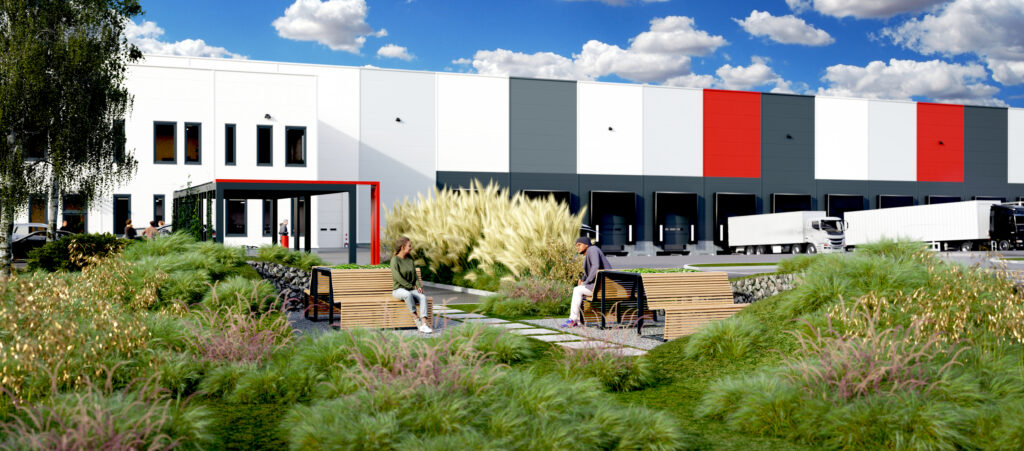
Low-carbon construction is the answer to climate challenges. We aim to cover all of Poland with green warehouses. We have secured land parcels that will allow us to build 3.5 million square meters of space. In Radzymin, we are currently developing a state-of-the-art distribution center for Żabka Polska—the most advanced facility of its kind in the Polish food industry. Reducing the property’s carbon footprint is a top priority for our client, which is why the center will be powered by photovoltaic panels, and we will ensure air quality in the truck maneuvering area by using special, dust-free paving stones and anti-smog towers.
explains Tomasz Lubowiecki
Meanwhile, in Balice, near Kraków, 7R has built the BWI Group’s research and development center, which uses a trigeneration system to generate energy—making the facility nearly self-sufficient. A gas turbine is used to generate energy for power, heating, cooling, and ventilation.
About the author
Author's Bio
Lilianna (Elżbieta) Laudy
Marketing & Digital Manager
Lilianna Laudy serves as Digital & Marketing Manager at 7R SA, where she is responsible for developing digital and marketing initiatives that support brand visibility and online communication…