Who builds the facilities used for industrial production these days? Most Poles believe that manufacturing companies themselves are responsible for this. Piotr Miodek, Head of BTS at 7R: Most investors turn to…
Who builds the facilities used for industrial production these days? Most Poles believe that manufacturing companies themselves are responsible for this.
Piotr Miodek, Head of BTS at 7R: Most investors, however, turn to developers for this. Few manufacturing companies currently have suitable plots of land available for expansion, and that’s where it all starts. The location of a new factory or warehouse is key to business success today. A developer has a portfolio of locations and can also secure land for the investor in the region of their interest. That’s how we operate at 7R. In addition to the location, the client receives technical know-how. If they were to build on their own, they would need a strong technical department staffed with civil engineers. Maintaining such a department, if construction takes place every few years—as is usually the case—has no economic justification. An investor who partners with a developer benefits from having the entire construction process handled on their behalf: from land acquisition, through obtaining permits, selecting a general contractor, to the final acceptance of the facility. We oversee the quality of the work, provide the legally required construction supervision, and take care of every detail.
Why is location so important? Don't companies want to expand "beyond their own backyard"?
Today, access to workers and transportation infrastructure are key. Sometimes a company owns land at a specific location but chooses not to build there because it knows that investing in that spot would be unprofitable. If a region is saturated with manufacturing facilities, a battle for workers begins—a bidding war to see who will offer more. This is already happening, for example, in certain industries in Lower Silesia.
Of course, many companies are expanding in the regions where they originated, as you said, right in their own backyard. They already have a trained workforce and want to make use of it. That’s one way to go about it, but they can also build in partnership with developers. This makes investing more flexible.
The Built-to-Suit model is specifically designed for collaboration between developers and investors in the manufacturing sector. What are its key features?
Built-to-Suit refers to the construction of a customized facility tailored to the specific needs of a client, in accordance with the specifications provided by the client. This is not a solution for clients who lease a small space in a business park for a short-term lease. Under the BTS model, facilities are built to serve a company over the long term, for at least 15–20 years. They are primarily intended for manufacturing operations, large-scale logistics supporting the dynamic growth of e-commerce, or may house warehouses with refrigerated spaces.
BTS clients are fewer in number than typical park clients, such as operators or warehouse tenants. Very often, they represent international corporations with specific expectations regarding the building to be constructed in the desired location. But that’s not all—the BTS system also involves the construction of buildings for domestic companies.
What does this look like from 7R’s perspective? When did the company first become interested in this model? What investments has BTS made so far? For which clients?
As a warehouse developer, the company has been in business for over 13 years. BTS projects have always been part of our portfolio. What’s new is that for the past few months, we’ve had a dedicated team focused exclusively on them. We recognized that a BTS client is somewhat different from a park client. That is why a separate team handles them—it consists of people with extensive construction experience in the warehouse and manufacturing sector for individual clients, who have participated in the implementation of some of the largest projects of this type in the construction market.
But getting back to your question, we’ve completed both large and small projects. It’s worth mentioning the building in Balice near Kraków for the BWI Group, a global supplier of automotive suspension parts. It’s only 10,000 square meters, but it’s a very interesting building: neither a manufacturing facility nor a warehouse. It houses a testing laboratory. It features rooms with controlled temperature and humidity, as well as an outdoor test track. In 2020, it received the Prime Property Prize for a green building—likely the first industrial, rather than office, facility in Poland to do so. It is energy self-sufficient thanks to a trigeneration system, its own domestic water intake, and on-site rainwater harvesting. Only gas is supplied to the facility. It is used to generate hot water for heating and cooling, as well as electricity.
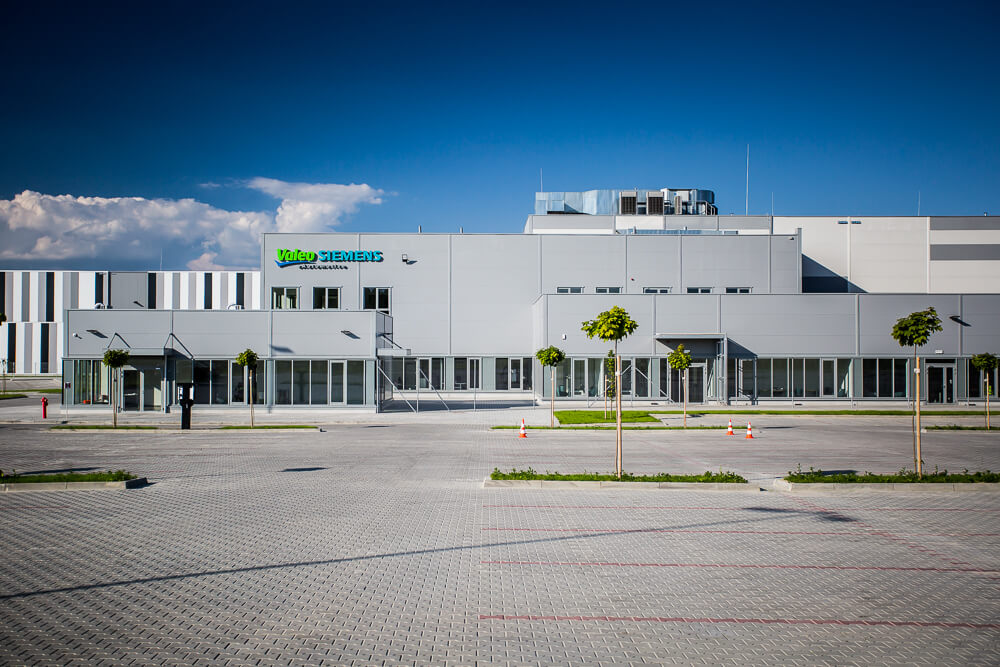
Our portfolio also includes a newly completed production facility for Valeo Siemens eAutomotive in Czechowice-Dziedzice. In Goleniów, we built a warehouse facility for the Hultafors Group with an area of approximately 30,000 square meters, equipped with extensive automation, including delivery robots powered by photovoltaic panels. We have also completed cold storage facilities, including one for Polomarket in the north of the country.
What are your main locations in Poland?
We have several in every major region. Upper Silesia and its metropolitan area remain consistently popular. Lower Silesia and the Wrocław area—despite labor shortages there—continue to attract clients due to their proximity to the western border. Poznań and its surroundings, the ever-growing Łódź, Warsaw, and the Tri-City—these are also leading locations. Less obvious choices include Szczecin and Rzeszów. We also have a large park in Lublin along the S19 highway and several locations in Częstochowa with great potential due to the A1 highway.
Building a BTS is, of course—albeit on a completely different scale—like the work of a tailor. What do the fittings and adjustments look like?
It depends on the client. For example, multinational corporations often have their own specific requirements for a building, since they have several or even a dozen locations around the world and their expected standards must be consistent everywhere; they have a specific location in mind, along with prepared specifications and reference drawings. We adapt these to Polish and local conditions. Another client comes in and says: I need X square meters of warehouse and production space, 70% of which is for storage and 30% for production; I need to hire 400 people—what can you offer me? We’re ready to work with both types of clients.
Indeed, our work is a bit like that of a tailor making custom-made garments. We don’t rely on a standard building specification; we build exactly what the client wants. If they want a sky-blue facade, go ahead—they’ll get it. I tell clients that in a building they’ll be using for 10, 15, or 20 years, everything must meet their expectations, so the more time we invest in the design phase and in finding solutions to meet the client’s expectations, the better the results will be.
Do customers ever visit the construction site?
Of course, I actually encourage that. It allows us to explain to the client why certain things are done a certain way, and in the final phase, we avoid any discrepancies between expectations and reality. Our motto is to help solve problems so that the client can focus on their own business. It is not their responsibility to have construction expertise—that is why they work with us.
How long does construction take?
8–12 months, depending on the complexity of the facility. What matters is what goes inside—the equipment, the technology, the automation systems—and how to integrate it all. After all, the client doesn’t make money on the building itself, but on what’s inside it, and these days, building automation is becoming increasingly advanced—often, the building is merely a shell for what is later installed within it. That’s why it’s worth discussing all of this thoroughly before breaking ground.
Are there any corrections?
When it comes to changes—of course. It’s like building a house. If you’re building with the expectation that the building will be used for 20 years, adding an extra window or putting up an additional wall to improve functionality is more important than the changes that result from it. Unless the client says the building isn’t where it should be, but things like that don’t happen (laughs).
It is said that BTS is a model for large, stable companies…
I’d say so. Although sometimes young companies that have been in business for 2–3 years are interested in BTS projects, their business has grown so rapidly that they need new facilities. Typically, however, BTS clients are large companies—both Polish and international—that have a long-term growth strategy and need a building in a specific region because they have a 10–15-year development plan for that area.
How does BTS appear on the company's balance sheet? Who owns the buildings?
It depends on the business model we agree upon with the client. We often develop projects in partnership with an external investor, who, as the owner of the property, ultimately sells it to the end-user. In other cases, we lease the building for several years, after which it is transferred to the ownership of our investment partner or the end-user.
Are there any examples in Poland of customers vacating BTS facilities before the end of their lease? Since BTS facilities are custom-built, is it possible to repurpose them?
Not very often. As I mentioned earlier, the companies that join BTS have long-term plans. As for adapting the space for another client, that is certainly possible, though it would be difficult to bring in a logistics operator with high-bay storage into a production facility. It’s easier to convert a warehouse into a production facility.
How is the pandemic affecting the market for warehouses and manufacturing facilities in Poland?
More warehouses are being built than before the pandemic, primarily for e-commerce. Large-scale projects will certainly continue to emerge over the next 2–3 years. There will also be smaller projects, as they are driven by major investments. Last year, total warehouse space in Poland exceeded 23 million square meters. According to experts’ forecasts, we will surpass the 25 million square meter mark in the coming months. The increased demand for warehouses is also evident in 7R’s operations. Compliance with ESG criteria is key to our operations, and we are seeing increasingly clear interest in this area from our clients as well.
Lilianna Laudy serves as Digital & Marketing Manager at 7R SA, where she is responsible for developing digital and marketing initiatives that support brand visibility and online communication…