The warehouse market shows no signs of slowing down. Despite the turmoil caused by the COVID-19 pandemic, warehouse and logistics properties continue to attract significant interest from both tenants and investors, which cannot be said about…
The warehouse market shows no signs of slowing down. Despite the turmoil caused by the COVID-19 pandemic, warehouse and logistics properties continue to attract significant interest from both tenants and investors, which is not the case for the retail or office sectors.
It is primarily the growth of the thriving e-commerce sector—for which urban locations remain crucial—that is driving the expansion of the warehouse sector.
The so-called “last mile”—the final leg of the delivery process to the end customer—had been vital to the e-commerce industry long before the coronavirus pandemic struck
says Paulina Kozłowska
Leasing Manager at 7R
“The pandemic accelerated trends that had been emerging for some time. Customers are becoming increasingly demanding when it comes to shorter delivery times, and a location within city limits ensures faster order fulfillment. In addition, e-commerce is transforming more and more market segments. For example, the lockdown-driven growth of the online grocery sector was an interesting development,” explains Paulina Kozłowska.
Not just e-commerce
Nonetheless, the tenant mix for warehouse properties located in cities is much more complex. There is a significant group of tenants for whom the appeal of a city location is determined by other factors as well. This group includes companies that want customers to be able to reach them as quickly as possible, unlike tenants focused on urban logistics. There are also companies that prioritize a certain level of access to public transportation for their employees.
“Our project on Osmańska Street in Warsaw, which is located near the airport and adjacent to an office complex, is a very good example. With excellent connections to the rest of the city, it poses no commuting challenges for employees,” says Paulina Kozłowska. “Quick access to an expressway or highway can be just as important,” she adds.
“When 7R’s City Flex initiative was launched, we expected tenants to be primarily logistics and distribution companies,” says Paulina Kozłowska. “But our projects on Osmańska Street and Działkowa Street partly defied this assumption. Today, these properties mainly attract customers with very high standards for warehouse facilities. I wouldn’t hesitate to call these projects small-scale BTS projects within an urban area,” she explains.
Location, location, and location
City Flex locations require early and appropriate planning, starting as early as the construction phase. In addition to carefully selecting the site, it is also necessary to carefully analyze the surrounding area and the potential customer base.
“This stage is essential for supporting the development of a city warehouse project,” says Kozłowska. “We carefully examine the location so that we can market the project to the right tenant at a later stage. In the case of BTS projects, we similarly work with our clients to choose the right location,” she continues.
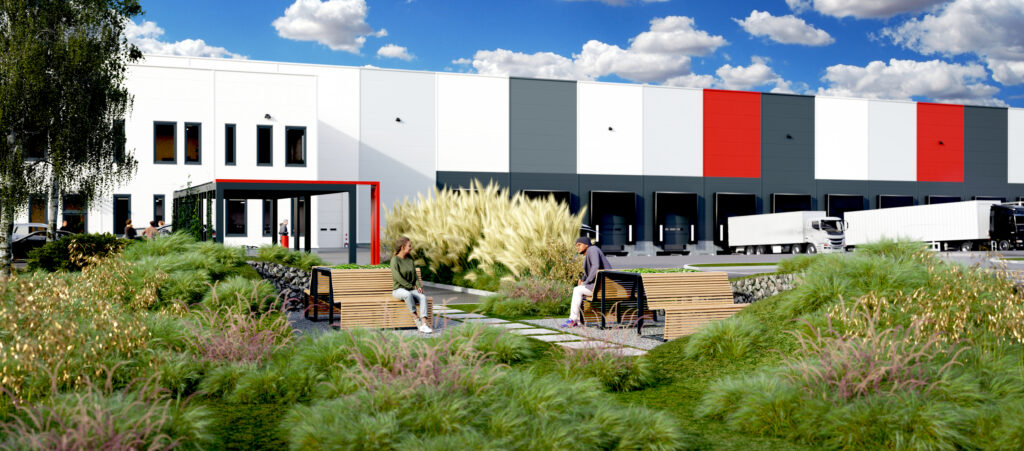
City Flex is betting on green solutions
With each passing year, tenants of urban warehouses are becoming increasingly demanding. Customer awareness is on the rise, as evidenced by the number and variety of solutions designed to improve operational and environmental efficiency in these types of projects.
7R, a Polish developer, employs many more innovative solutions of this kind and aims to set new trends.
“All our new buildings are being equipped with LED lighting (using the DALI protocol), which has become standard practice for 7R. In addition, every new project includes a solar power system and a charging station for electric vehicles,” Paulina Kozłowska notes.
Customers not only ask about innovations, but they also expect developers to provide them. That is why at 7R, in addition to standard market solutions, we use many other technologies, such as destratification fans, which allow us to use the warm air accumulated at the highest levels of the warehouse to heat the entire building. We also use PIR technology when insulating our buildings, which provides a better thermal transmittance rate than the currently widely used mineral wool. This is not yet standard on the Polish market.
adds Paulina Kozłowska
About the author
Author's Bio
Lilianna (Elżbieta) Laudy
Marketing & Digital Manager
Lilianna Laudy serves as Digital & Marketing Manager at 7R SA, where she is responsible for developing digital and marketing initiatives that support brand visibility and online communication…