Among the many important aspects of running your own business, there is one that often doesn’t come to mind right away—namely, warehousing. Choosing the right warehouse space is crucial to the effective operation of a business.
Organizing warehouse space – where to start?
Before we start organizing our warehouse space, we need to be aware of a few key details to do it right. We should therefore:
● know the size of the storage area
● have a suitable warehouse design
● know the quantity of goods that will be stored in the warehouse
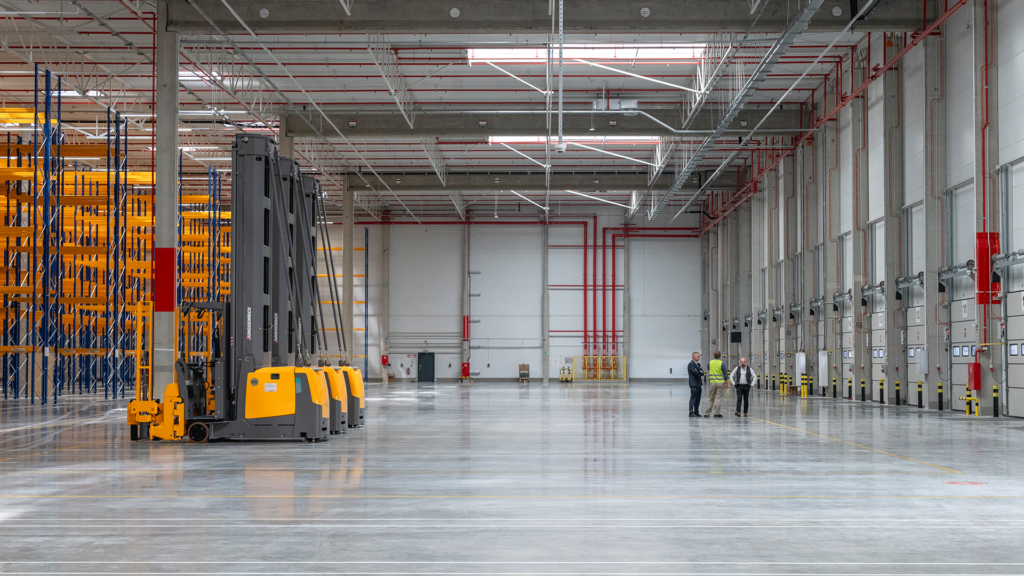
● Know the type of equipment that will be used to move goods indoors (e.g., forklifts)
● know how to arrange merchandise in the warehouse
We also need to know how many people will be hired to staff the warehouse.
It’s also worth considering the warehouse layout you choose. You can choose between a through-type layout (low product turnover and large shipments), an L-shaped layout (diverse product turnover), or a bag-type layout (diverse product turnover and small shipments).
We should also keep in mind the need for an appropriate IT system to manage our warehouse —new technologies can significantly streamline all operations that take place in the warehouse.
Warehouse Space Optimization – What Is It and How Can You Achieve It?
Before we explain exactly what effective use of warehouse space entails, let’s first define what optimization is in theory.
Optimization means finding the best possible way to solve a problem. Therefore, when it comes to optimizing warehouse use, it involves effectively planning the entire space.
We already know the factors that will help us make the most of the space when selecting a warehouse. Once we’ve chosen a specific facility, we should also consider:
● proper layout, which includes storage zones (divided by product category)
and
● Planning the internal warehouse routes along which goods will move each day and adapting them to subsequent stages
Once we have all this information, we need to determine the total storage space we will need, then plan how to store the goods and calculate the maximum storage height.
In addition, we need to know:
● What type of shelving should we use?
● Which pallets should we choose?
● How we will fulfill orders
To be more precise, a well-organized warehouse is one in which:
● The things we need most often are easily accessible
● It’s easy to get around in—not only on foot, but also by forklift
● The goods are securely placed on the shelves (so that they are not damaged, but also so that they do not pose a hazard to anyone).
Choosing the Right Warehouse Shelving
Now that we know all the specifications of our warehouse space, we will be able to select the right shelving units to help us optimize our warehouse logistics.
Currently available on the market are:
● shelving units
● fixed pallet racks
● flow racks
● sliding shelving units
● cantilever racks
● drive-in racks
Shelving units are an excellent choice for small warehouses. Their height can be adjusted as needed, making them very spacious. They often include additional components such as drawers, rods, dividers, partitions, and drawer cassettes.
Fixed pallet racks, as the name suggests, are permanently anchored to the warehouse floor. They can be configured for single or multiple pallets. This is a very popular option.
Flow racks are racks in which the items stored on them move forward as they are removed. Mobile racks are equipped with rolling mechanisms. These allow rows of racks to be moved along tracks installed on the floor. Cantilever racks are ideal for storing goods of varying lengths (technically speaking, for storing long materials). Their design allows for the storage of heavy goods.
Another option is drive-in racking, which allows forklifts to drive between the racks.
Once you’ve selected the shelving units for your warehouse, it’s also important to keep in mind the proper guidelines for storing goods on them. What should you keep in mind?
- Heavy items and those that are easily breakable (such as glass) should be placed on the lower shelves of the bookcases.
- The items we reach for most often should be as easily and quickly accessible as possible.
- Consequently, items we use less frequently can be placed on the upper shelves.
What are the benefits of optimizing warehouse space?
Simply put, effective space utilization has a very positive impact on the operational efficiency not only of the warehouse itself, but of the entire company.
Although it may seem at first glance that this is just a small part of the space and there’s no need to organize it in any special way, it’s only after careful optimization that we realize what a positive impact it has had on the overall performance of our business.