
Sustainability and the pursuit of its goals within companies (ESG) are having an increasingly significant impact on business strategies and operations, including those of developers and clients in the warehouse market. Piotr Miodek, Head of BTS at 7R, explains what this shift means for the market.
– Where does the interest in ESG in the warehouse market come from, and what is the current focus?
Piotr Miodek: Companies —including tenants and investors—motivated not only by new legislation but also by shareholders, customers, partners, and competitors—must minimize their negative impact on the environment, climate, society, and ultimately the economy, while simultaneously increasing their positive impact. So everyone has their own path to follow here—at a pace that suits them and their industry. However, the most important common goal for everyone in this regard in Poland is currently moving away from coal-fired power generation, as well as reducing the carbon footprint by, among other things, limiting local emissions. In the case of warehouses, to achieve this, customers are primarily switching to alternative, cleaner energy sources. Some are turning to photovoltaics, others to innovative gas-fired cogeneration, and still others are moving away from gas entirely. As part of our ESG policy, we carefully identify and analyze these diverse customer needs and goals and respond to them.
– How advanced are warehouse customers in their ESG strategies?
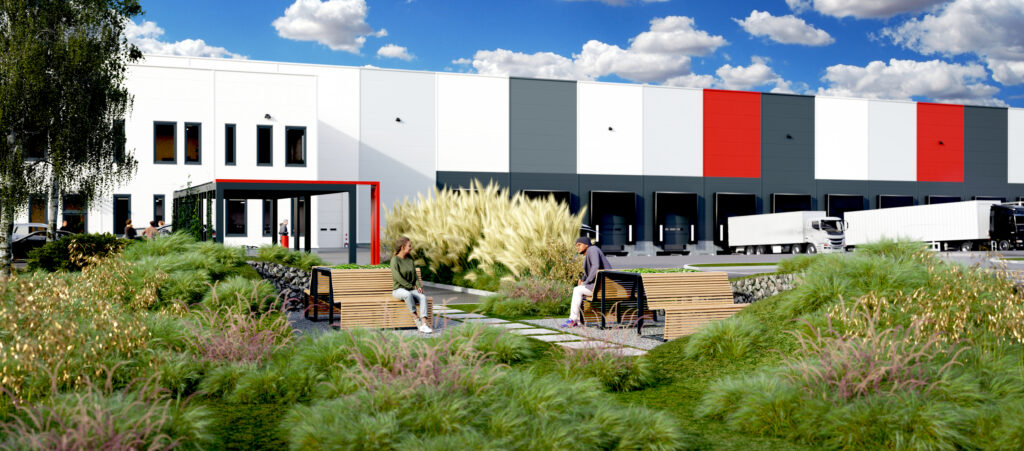
Customers are beginning to understand the importance of ESG. We see that companies and industries are at very different stages of ESG development. That is why, for those who expect it, we strive to serve not only as a developer but also as a green guide. We build projects in an eco-friendly format because we understand their environmental, social, economic, and business significance. That is why, as standard and at no extra cost, we offer many solutions that make the building more environmentally friendly and employee-friendly (including thicker insulation, heat-reflective facades that blend with the surroundings, solar panels, rainwater harvesting for landscaping, and employee rest areas). We demonstrate how significantly such facilities reduce companies’ carbon dioxide emissions (by as much as approx. 400 tCO2 per year for a 20,000 sq m warehouse) and their energy consumption (by as much as 50% per year). We discuss with clients not only how this will positively impact their future environmental and energy assessments or audits, ESG ratings, or reporting obligations, but also—or above all—how much less their building’s operation will impact the environment around us.
– What do customers expect from developers?
On the one hand, they seek solutions that offer tangible benefits in helping them meet ESG requirements; on the other, they seek an understanding of—and, to some extent, the implementation of—their sustainability strategies. Tenants and investors are beginning to measure and reduce their environmental impact across operations and supply chains, including in the construction, leasing, and operation of buildings. They are therefore looking for partners who can help them with this: partners who will not only provide green solutions and buildings but also will not burden them with their own environmental and social footprint, as they will share a similar approach to responsible business. Otherwise, they risk higher operating costs or a faster decline in property value, as well as higher capital costs and legislative, market, and reputational risks for their business.
– Nothing companies do—whether positive or negative—happens in isolation from their environment. Is it the same at 7R?
Of course. Our ESG policy isn’t just about green building. It also encompasses, among other things, ethical sales practices, collaboration, and communication policies. We keep a close eye on expenses and actively discourage solutions that lack practical value or would entail unnecessary costs and risks for the client or the environment over the long term. When we see that customer expectations are based on incomplete or false marketing messages—or greenwashing—we honestly point this out, advising on the most beneficial solutions—for them and for the environment. An example here is the use of graywater recycling in and around a building. While this popular solution works great for irrigating green spaces, its use in restrooms carries the risk of more frequent and higher maintenance and operating costs in the future—the client needs to be aware of this. This is what responsible business and partnership look like in practice, in our view.
– What new ESG initiatives can we expect to see in the warehouse market?
I see significant growth potential in the increasing use of heat pumps in warehouse buildings. The possibilities for storing renewable energy generated on-site—for example, from photovoltaic systems—also look promising. Clean energy stored on sunny days could be used by the tenant or owner to power forklifts or charge an electric fleet on days with unfavorable weather.