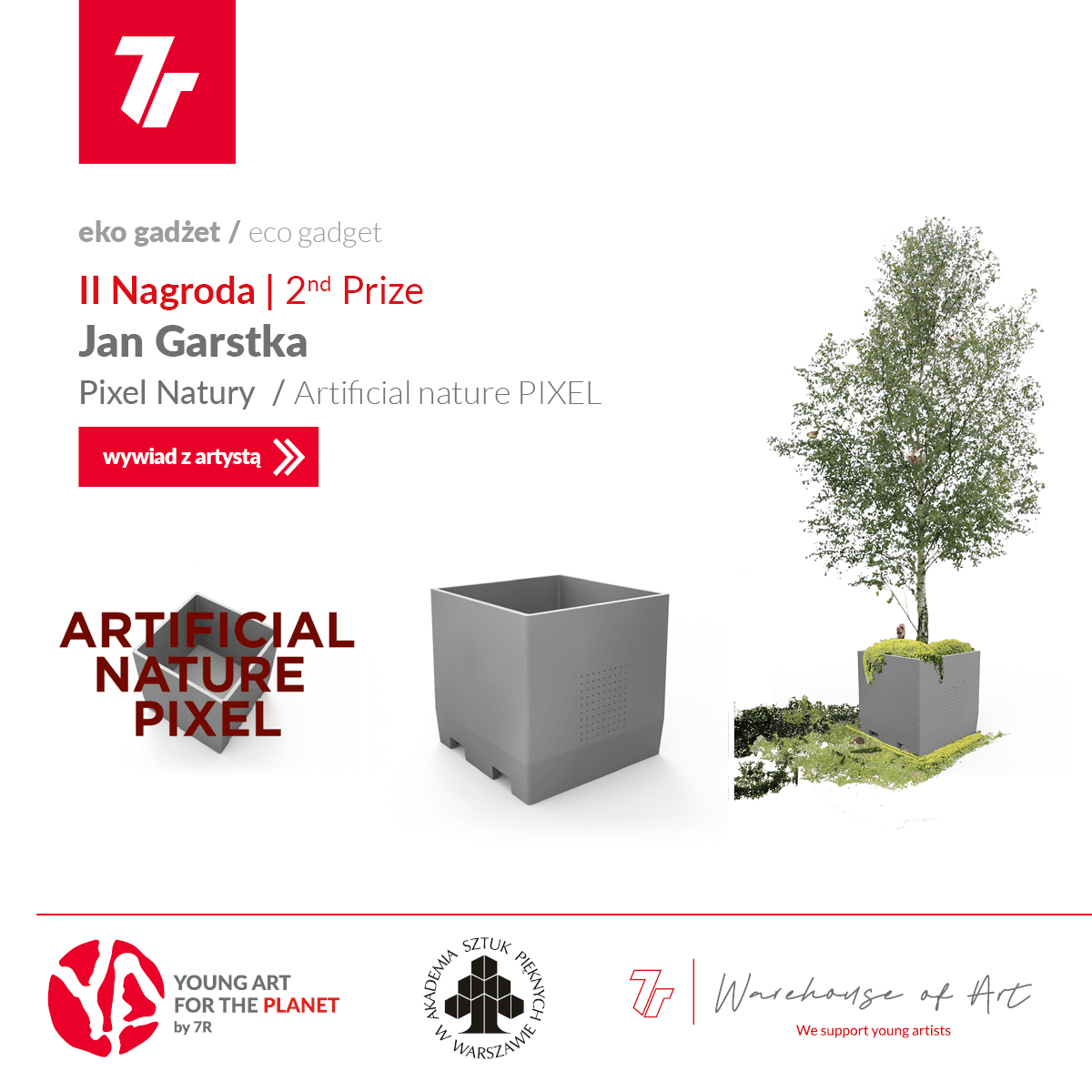
Jan Garstka—winner of second prize in the 7R competition “Warehouse of Art: Young Art for the Planet” in the eco-gadget category—talks to us about artists’ commitment to improving the world around us. He also argues that many interesting and socially and environmentally responsible projects can be implemented by companies without compromising their profitability.
What inspired the creation of the “Pixel Natury” project—a container that serves as both a large planter for plants and a habitat and micro-corridor for animals, is easy and cost-effective to produce, and is also convenient to transport?
Jan Garstka: Before I began my studies at the Academy of Fine Arts, I studied biotechnology. So the idea of working for the benefit of nature is close to my heart. There, I focused on environmental biology, among other things, and participated in research on various types of animals. This allowed me to gain significant knowledge about the presence of animals in spaces created by humans. The direct inspiration for my project was a study conducted by scientists from Warsaw in Skaryszewski Park. The park was slated for redevelopment. However, research by a group of biologists showed that rebuilding the transportation infrastructure—including alleys, paths, etc.—would reduce the park’s biodiversity. This would have catastrophic consequences for the surrounding area, such as a decrease in the number of nesting birds, which would in turn lead to an increase in the number of insects; the number of small rodents, such as squirrels or field mice, would also decline.
As a result, I began focusing on animal habitats and crossings. On a large and medium scale, animal crossings between habitats already exist and work very well. These include overpasses over highways or small crossings for amphibians and other smaller animals. On a small scale, however, such structures are lacking. My goal was to create elements that would fit into the urban landscape, be transportable, serve as a refuge for flora, and provide shelter for fauna. This is how “Pixel of Nature” came to be. It is designed to be used by cities, companies, as well as ordinary people.
It seems that nature plays a prominent role in your work…
It’s something I think about. Unlike theoretical physics, nature is something we all experience, and to some extent, we all influence it, and it influences us. It’s a rich source of inspiration that can be used to improve the way the space around us functions.
The environment affects us, and we affect the environment. How can artists raise public awareness about caring for nature?
I hope so, through projects like these. The artist provides an opportunity—or rather, compels us—because there is an element of compulsion in our work. I am a product and visual communication designer; I focus on designing objects that can be mass-produced and will influence people in line with current development concepts. As designers, we try to encourage companies toward more eco-friendly production, not only in line with our personal convictions—which are, of course, present—but also due to commercial and legislative considerations. We should anticipate these in our work.
As an artist, I believe we must challenge people, put them in uncomfortable situations that may cause some embarrassment but encourage them to reflect on various issues. Artists are trained to push reality forward. Creating art that is merely comfortable doesn’t appeal to me.
Can you tell us what projects you’re currently working on?
As part of the TAKŁADNIE Designers’ Cooperative (www.takladnie.com), we work on industrial design projects for clients that involve, among other things, biology education. However, I cannot disclose any specific details. Through the cooperative, we always strive to contribute something constructive to the world around us. We decided to stay in Poland and Warsaw as designers in order to shape the national reality as responsible creators.
Governments, cities, companies, and corporations can take action to protect the environment, but a lot also depends on ordinary people. How does this play out in your daily life?
I encourage everyone around me to sort their trash meticulously. I try to do this myself and urge others to actively think about our impact on the environment—for example, by using the right cleaning products and modes of transportation, heating their homes properly, and making responsible consumer choices.
What do you think of the 7R competition “Warehouse of Art: Young Art for the Planet”?
Such initiatives raise the profile of young artists and give them the opportunity to bring their concepts to life. This may encourage companies to invest in socially responsible projects that can also be fully commercialized. When we design something, we consider whether a given solution can actually be realized. There are many factors that influence the implementation of individual projects, but such implementations can happen. Many ideas emerge that make economic sense, so why not use them if they can improve the world even just a little?
About the Warehouse of Art Competition
The 7R competition, “Warehouse of Art: Young Art for the Planet,” was open to students and graduates of the Academy of Fine Arts in Warsaw. Its theme was “Technology. Ecology. Human. Coexistence.” The competition task was to create an eco-themed applied art project in one of three categories: an ergonomic seat, a mural for a fire hydrant, and an eco-friendly 7R gadget. A total of 26 entries were submitted to the competition. The winners’ works are available at7rwarehouseofart.pl.