Good morning. My name is Tomek Szpyt, and welcome to another episode of the 7R.Blog.On podcast series. My guest is Aleksander Kuśniewski, a business development director at 7R. Good morning.
Good morning.
Aleksander, there’s a trend that I think we’re all seeing, though, which is that retail has picked up speed.
Yes, yes.
How has this acceleration affected the warehouse market?
And we need to stay on top of market trends to increase the share of e-commerce in our daily shopping habits.
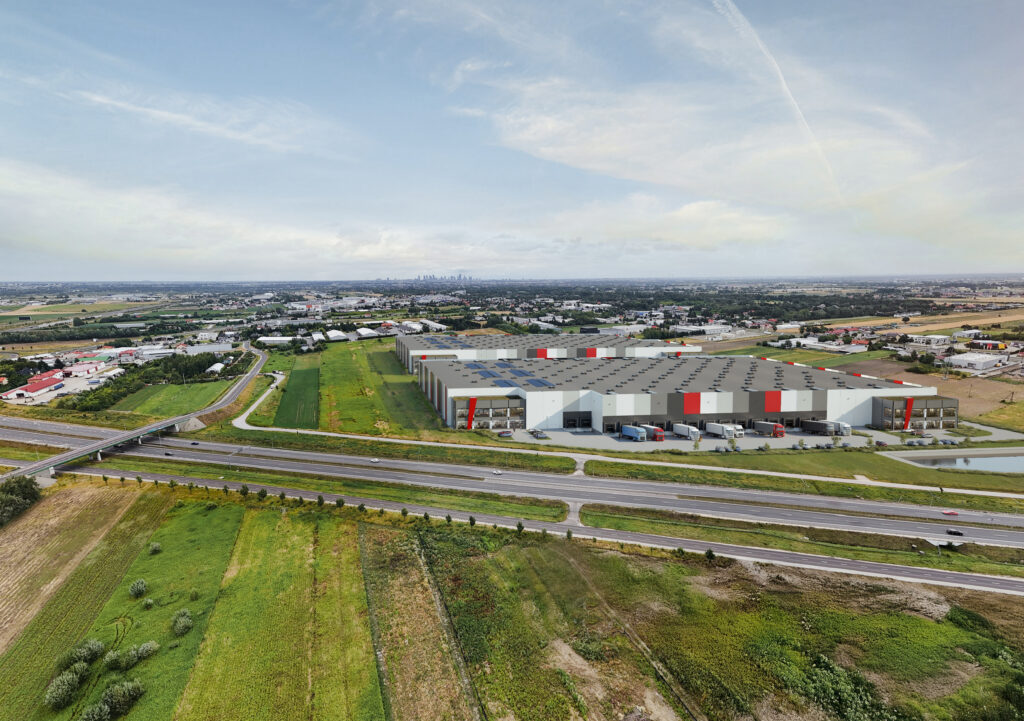
We are seeing growing interest in urban warehouses. We will be expanding our presence in cities more and more. We will become increasingly visible within the urban landscape.
What challenges does this present for a developer when it comes to establishing a warehouse that may be associated with a facility located outside the city—but closer to city centers?
It’s definitely a social responsibility. After all, we have neighborhoods. The neighbors can protest too. We have to convince them that our warehouse will blend in with the surroundings, that it won’t be a nuisance—and it may even turn out to be a convenience, that it will be aesthetically pleasing and attractive enough not to disrupt the harmony of the city. We are in such a favorable position that we often have buildings intended for warehousing or warehouse services—increasingly, this involves demolishing old buildings or factories and simply replacing them with modern structures. This also makes it a little easier for us to convince the community of the need for such investments. On the other hand, sooner or later these warehouses will likely prove useful to the neighbors. Perhaps they will serve as a delivery hub. It may turn out that it will be easier to deliver perishable goods within minutes or hours, so I think this is quite beneficial. Of course, people will be concerned about increased truck traffic. However, these deliveries can be organized in many different ways.
As the director responsible for development at 7R, where and in which areas do you see growth opportunities for the company?
The potential for logistics is enormous. In Poland, there is probably half a square meter or 0.6 square meters of warehouse space per citizen. In the Czech Republic, it ranges from 0.7 to 0.8 square meters, and in Germany, from what I have read, it is one square meter or even 1.2 square meters. On the other hand, many warehouses in Poland were actually built in response to demand from the German market, so our supply of space is also somewhat distorted. The potential is huge in every area. The potential is also huge in the area of large warehouse space—big boxes serving large-scale logistics. Every order that comes to us passes through three or four warehouses along the way, whether from courier companies or companies that deliver products. Let’s not forget that later on we also have to handle returns. The package we ordered with four pairs of shoes—it goes back to a completely different warehouse with three pairs of shoes. We need about five warehouses for every order, for every click we make online. We’re going to click more and more, so the first area is definitely large warehouses and large-scale logistics. What we just discussed—bringing warehouses into cities. We’re going to want it faster and faster. Probably ten years ago, when we were connecting to the Internet via Telekomunikacja Polska—sorry, more like twenty years ago—it was pretty cool if the product was available within 5–7 days. Now, if it’s not available within one to three days, we’re convinced that someone is making a fake offer. I’m kind of joking like that. What we just said—that we’ll need it on the same day or within a few hours. We need to get closer to the people with the magazines as well, so this kind of format… Maybe it won’t be going into city centers. Maybe the answer to this will be existing commercial facilities, stores. As if for this already really last-mile delivery, but we will have to be on the ring road of such a city—with the possibility of supplying these points also within minutes or hours. If it will be serviced. This is the second area. The third area—the databases. In order to handle such massive Internet traffic—and to comply with all regulations—we will likely also need databases and server rooms. That is another direction we, as a developer, are addressing.
You mentioned ordering four pairs of shoes and returning three pairs. This practice is actually very harmful to the environment. All those shoe packages have to be transported somewhere. They pass through three or four warehouses. They reach the customer. The customer makes a choice, and the shoes are sent back somewhere else. This only increases the carbon footprint. How can you help reduce the environmental impact of logistics and the warehouse market in general? What role can a developer play here?
We are already doing this. It’s not a question of, “What could be the role of the developer?”, but “What is the role of the developer?”. This is not the future. Let’s not view decarbonization as something that’s still to come. It’s something we’ve been doing for a long time. What I’m most excited about are the simple solutions being implemented that are having a significant impact. There are heat exchangers that distribute heat evenly across the entire warehouse volume. There is additional insulation, thicker walls, and a thicker roof. There are seals on the loading docks. These are many elements that, as a developer aiming to place our product in the A++ category, we are already implementing. These result in tangible savings in energy consumption. I believe that given today’s situation—with rising energy costs and growing corporate awareness of the need to care for the environment—we can see that the paths of expectations regarding the climate and the economic trajectory have converged. We can see that the trajectories of expectations regarding the climate and the economic trajectory have converged, such that now the payback periods even for photovoltaic installations are no longer measured in decades, but rather these are tangible savings that can easily be demonstrated to customers, proving that it makes sense.
Can you suggest solutions that will lead to savings for tenants? And later on for investors, and eventually building owners—I don’t know… in a year, two, three, or five? Where can we further tighten the screws on energy savings and environmental standards? Where can we look for ideas here? In which areas?
In terms of solutions, we can still make a difference… A few months ago, we joined the Proptech Foundation, an association dedicated to innovation. They introduce innovative products, often from startups and companies striving to develop new solutions. And we’re actively involved in that. We identify and adopt such innovations. The future can surprise us very quickly. I think 7R was the first company to make LED lighting the standard in warehouses. Not so long ago—let’s say ten years ago—a fluorescent lamp was a basic piece of equipment in every warehouse. And so were aquariums. 7R was the first company to introduce LEDs as the standard. Now we are the first company to introduce LEDs with the DALI protocol. This is a control system that allows dimming of lighting based on daylight or motion detection. And this is one of those innovations for which, until now, the customer had to pay extra. We introduce every such innovation. We try to stay a step ahead. We try to show the customer: “Hey, listen. With us, you don’t have to pay extra for this. We provide it as standard, and thanks to this, you gain an additional point in your rating. In the rating of how you care for your employees. How you care for your employees, how you care for the environment—this building ages more slowly. People work better. As people work better, they’re more efficient.
Will new solutions continue to be implemented in warehouses? Warehouses will continue to evolve, and that evolution certainly won’t stop, will it?
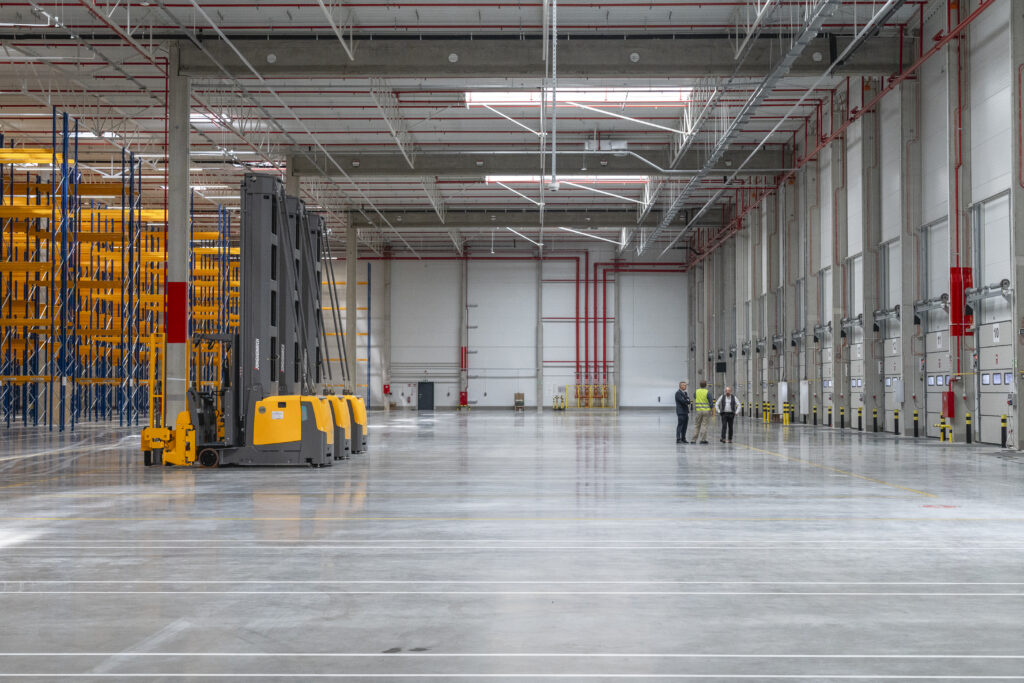
The warehouse will remain a warehouse. The challenge facing logistics in general is staffing. Our customers already have systems such as MiniLoad and AutoStore. This is full automation. These are the robots. Ten of these robots consume as much electricity as a vacuum cleaner, so we minimize energy consumption. We maximize efficiency with AutoStore—these are thousands of packages that we would normally have to store in a huge space. Here, we can make more efficient use of this building’s volume.
Thank you very much. Our guest today was Aleksander Kuźniewski, a business development director at 7R. I’d like to invite you to another episode of the 7R.Blog.On podcast series.