– We should opt for eco-friendly materials and sustainable production methods. In the realm of art, the artist serves as an educator, and it is important for them to convey the values they believe in –…
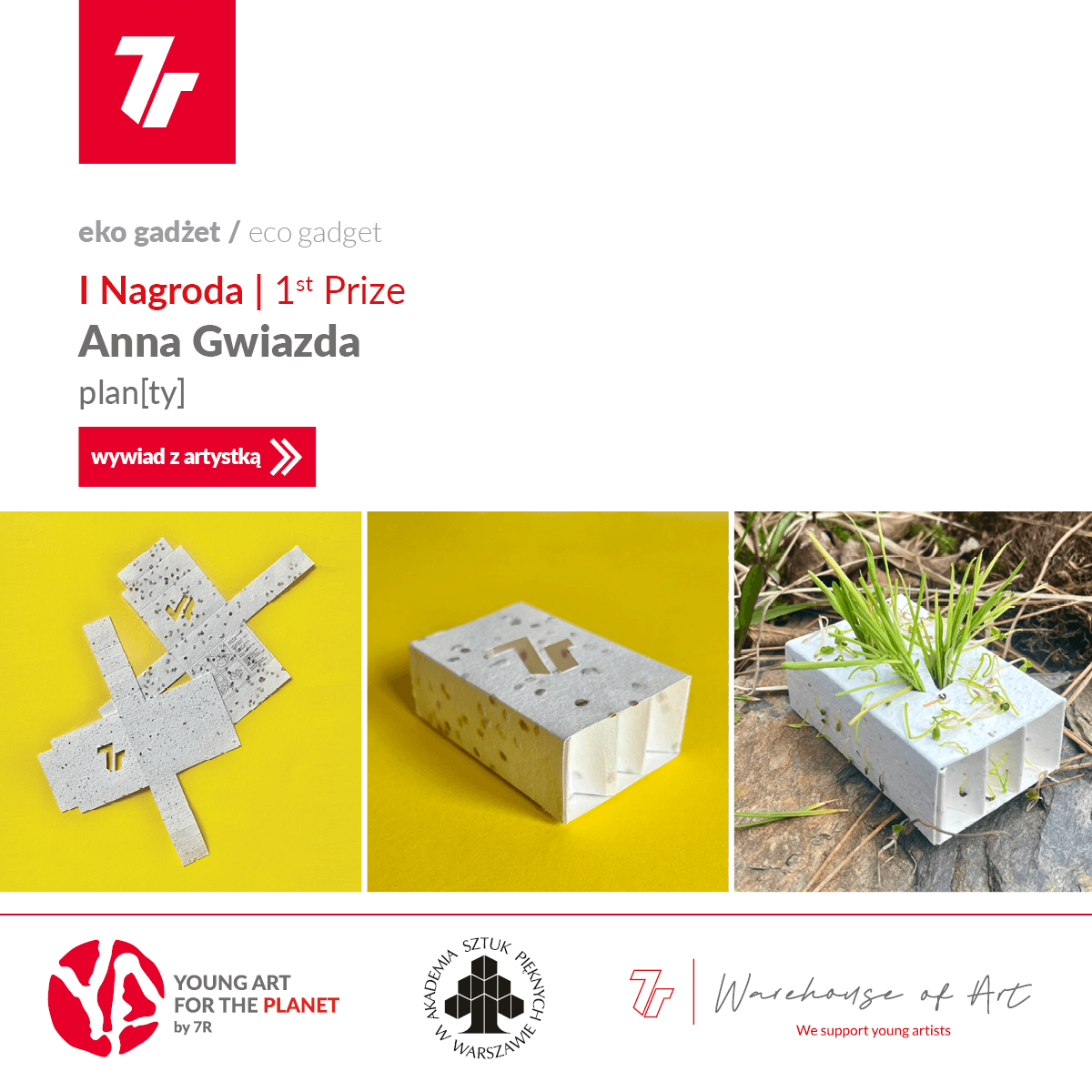
– We should opt for eco-friendly materials and sustainable production methods. In the realm of art, the artist serves as an educator, and it is important for them to convey the values they believe in, says AnnaElizaGwiazda, who won first prize in the 7R “Warehouse of Art: Young Art for the Planet” competition in the eco-gadget category thanks to her “plan[ty]” project.
The designer proposed a gadget made of biodegradable handmade paper containing plant seeds that, as they sprout, will gradually break down the material.
From the very beginning of this project, I assumed that it shouldn’t be an object associated with a typical gadget—in other words, something that’s essentially superfluous. That’s not my philosophy when it comes to design and my relationship with objects. In my opinion, the interaction itself is more important than the act of ownership.
Translated by Anna Eliza Gwiazda
Biodegradable mini-bin
The artist herself describes the “plants” as taking the form of a miniature magazine, whose paper design is inspired by origami. The seeds used are a mix of Polish meadow plants, which may serve as an added attraction for international customers. Thanks to the interaction created, the use of the gadget will be prolonged and will engage the recipient in the process of plant growth, creating a bond between the user and the gadget. The users of “plan[ts]” can be the three parties involved in the interaction: the giver, the recipients, and the environment.
“My goal was to design an object that would outlive the person receiving it. I always wonder if I’ve properly captured the ecological message in my designs,” says the winner of the 7R competition.
In the eco-space
The eco-friendly aspect is evident in every detail of the eco-gadget designed by Anna Eliza Gwiazda. Instructions for assembling the box and caring for the seeds are printed directly on the inside of the box wall, so the “plan[ts]” require no additional packaging and can be transported and stored flat. In this way, the production of the gadget itself is designed to generate a low carbon footprint.
“In the case of the ‘plants,’ I chose paper because it biodegrades very quickly. The germination of seeds and the growth of plants, on the other hand, illustrate a process of change. Origami, meanwhile, is not merely an element of Japanese culture—it has been present in all cultures around the world; moreover, it occurs in nature and manifests itself through its mathematical precision,” the artist believes.
Educators who get to the point
In her view, designers have an important role to play in designing products that, throughout their lifecycle, impact not only the user but also the environment.
We should opt for eco-friendly materials and their sustainable processing. In the realm of art, the artist also serves as an educator, and it is important for them to convey the values they believe in. The form of this message depends on individual preferences. Not only artists, but everyone should take responsibility for the world we live in.
says Anna Eliza Gwiazda
The artist is a co-founder of the TakŁadnie cooperative and works professionally as a designer of therapeutic equipment and toys, but she strives to develop her skills in many different fields.
“ I recently designed a tool for recording memories, a sort of personal journal. I undertook this project in collaboration with therapists and refugees. I also recently tried my hand at designing functional glassware, which was quite a challenge for me,” says the designer.
About the Warehouse of Art Competition
The 7R competition, “Warehouse of Art: Young Art for the Planet,” was open to students and graduates of the Academy of Fine Arts in Warsaw. Its theme was “Technology. Ecology. Human. Coexistence.” The competition task was to create an eco-themed applied art project in one of three categories: an ergonomic seat, a mural for a fire hydrant, and an eco-friendly 7R gadget. A total of 26 entries were submitted to the competition. The winners’ works are available at 7rwarehouseofart.pl.
About the author
Author's Bio
Lilianna (Elżbieta) Laudy
Marketing & Digital Manager
Lilianna Laudy serves as Digital & Marketing Manager at 7R SA, where she is responsible for developing digital and marketing initiatives that support brand visibility and online communication…