Tomasz Szpyt: Good morning, everyone. My name is Tomasz Szpyt. Welcome to the 7R.Blog.On podcast series. Today we are pleased to welcome Joanna Lewandowska—Head of Design and Construction at 7R. Today we’ll be discussing how to properly design a warehouse. Where do you start? What is important in warehouse design? How does it differ from designing other types of buildings? Joanna, you have experience in residential construction. Now you’re working for a warehouse company. How does designing a warehouse differ from designing an apartment building?
Joanna Lewandowska: In terms of the process, it’s very similar. You could say that when it comes to preparing the project and then carrying it out—that is, implementing the investment—there are essentially no procedural differences. However, of course, the product is different. So all the complications, threats, and risks—associated with one product or another—are appropriately tailored to that type. Residential real estate is about the scale of clients. Here, the fundamental difference is that we have, for example, a thousand or five hundred apartments. A certain number of families, and so on. We have to deliver to all these people their dream homes—the ones they’ve longed for, cherished, and eagerly awaited, and which are very expensive. Here, we generally have just a few clients, and sometimes perhaps only one. I think that’s the fundamental difference. Of course, the technology is also different. All risks related to defects—that’s a completely different area, but a building permit is obtained according to the same regulations, according to the same requirements. Based on similar documents, or even the same documents, in principle. We also prepare all technical studies related to the environment. We always obtain an environmental decision and technical conditions. We must comply with the local zoning plan—that is, with the regulations. We organize a tender and select a general contractor. The entire process of design, construction—and then also state inspections and handover to the client or tenant.
You mentioned that there are many similarities. Customers also differ—you mentioned that as well. Which type of customer is more demanding? Residential customers, or logistics and warehouse customers?
Everyone has their own set of expectations. I don’t think you can say which is more demanding. If I’m buying an apartment for half a million zlotys and that’s my life savings, then I’m extremely demanding. Although there are also people who are very trusting and have no complaints—they accept the product without any issues, for example. Tenants are institutional clients. Here, there are different cost levels, different levels of involvement, and different levels of expectations. Sometimes there are very demanding clients during this stage of adapting their space. It’s very common for new ideas to come up during the project’s implementation, execution, or construction. These ideas are likely very good, important, and significant for the future tenant. However, not all of them can be implemented at a given stage. Various discussions, negotiations, and such processes take place, which are sometimes very labor-intensive and demanding. Sometimes they’re also heated. It varies. At the end of the day, we’re always talking to people. If we’re in the permitting phase—that is, obtaining all the necessary decisions, opinions, and so on—then we talk to officials; they’re people too. In my experience—regardless of the industry—the most difficult stage of the entire investment cycle in real estate development right now is precisely this permitting phase. That is, the project plus all the supporting documentation, because what’s difficult and complex are sometimes—not even the regulations themselves—but the way specific officials in different regions of the country interpret those regulations. It’s interpreted differently. So here, too, at the end of the day, it comes down to that human interaction with the person who makes that interpretation. Agree or not. It’s similar with tenants. It’s similar in this process with our clients—later the end users who buy investments from us, who also have their own expectations. They have their own goal to achieve. Organizing all these processes so that, first of all, we see this goal as a shared one—is difficult. It’s also often difficult, I think, to convince these people that this really is a shared goal.
You mentioned that even designing a warehouse is no walk in the park. Technology is supposed to make our lives easier. We live in an era of technological revolution that affects virtually every aspect of our lives. I think this applies to warehouses as well—buildings from ten years ago are a completely different product than those being built today. To build more complex systems and more complex buildings, you probably need to use slightly more advanced tools as well. What is the modern architect’s arsenal? What do they use?
You’ve certainly touched on an area that is currently extremely important in the design and construction processes, as well as in later management. Looking at facility management. As I said—completely in isolation—it doesn’t matter what kind of facility it is. Whether residential, retail, warehouse, or office—it’s about the design approach. In the past, and quite recently, design was essentially done in two dimensions. That is, in two dimensions. To this day, a great deal of design is still done this way. However, for some time now, BIM technology—Building Information Modeling—has also been developing. It’s a comprehensive technology that brings together many different elements and aspects of the design process. There are also design tools developed for this, such as 3D ones. That is, designed in 3D. Usually, Revit or Archicad is used. From experience, I see that Revit is more popular. However, completely separate from the design process—one could say that this BIM technology is very interesting—because it involves creating a virtual space where all parties involved in the design process can find the elements relevant to them. So, a three-dimensional object is created, to which physical characteristics and parameters are assigned. For example, you can specify the thermal resistance of that object. You can specify the supplier of the materials. You can specify other physical and thermal insulation parameters, and so on. What’s more—this object can be built or modeled not only in three dimensions, but also in four or five dimensions. Because to our three basic spatial dimensions, we can add a cost dimension, and at the end of the day, we can also add a time dimension. So we have a certain investment in terms of money and time—when it should be completed. Once these parameters are activated, we can see and model—for example, whether a given facility, such as a warehouse, is being completed on time according to the scheduled timeline—and which of its specific structural or construction elements are highlighted in red—meaning they should already be completed but are not yet as of today. This is a very complex tool for managing an investment or project that offers many possibilities. It’s a world where all the characteristics of this facility are brought together, and the number of these characteristics and parameters that can be assigned is truly almost limitless. So everyone involved in this process can benefit from it.
If I understand correctly, this technology allows you to first create a digital model of a building—before it is actually built on a specific plot of land—and to monitor the construction process. Does this technology also offer any benefits later on to tenants, the building’s eventual owners, and investors? Could you briefly summarize the benefits of BIM in a few sentences?
One clear benefit is the sheer amount of information incorporated into this project, created using this technology—information that simply cannot be included in a two-dimensional design. Another benefit is the ability to quickly identify clashes. Whether they involve MEP systems, or MEP combined with structural elements. Any conflicts, really, which in traditional design are generally found very often—if not most often—at the construction phase. This greatly complicates and increases the cost of projects. At the end of the day, of course, this system has—as I mentioned—the capability to parameterize everything. Starting with the type of lighting fixtures, light sources, facade type, series types, and various other elements. Consequently, for example, for someone managing this facility—it’s a huge help, because if any part of the facility isn’t functioning as it should—it’s very easy to determine from this model what kind of component is missing. Who the supplier was, what its technical specifications are, and where it can be ordered—this is a wealth of information, especially from the perspective of managing a facility that is already in operation.
We’ve said that over the past decade, warehouses have essentially evolved from simple cubes, from simple boxes—as they used to be described. Now we have highly advanced buildings equipped with very complex systems. In your opinion, what might warehouses look like, say… in another decade? What innovations can we expect in the design of these types of buildings?
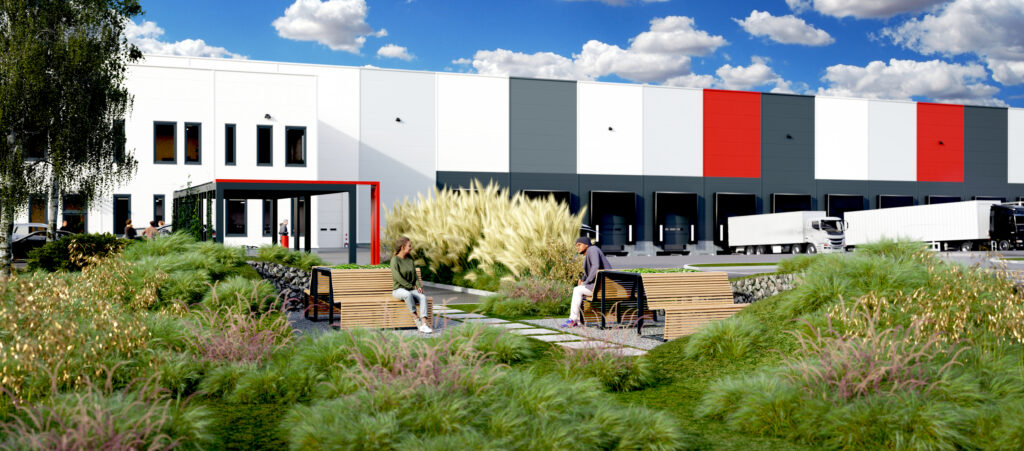
I think that all the latest technological innovations and market trends—which office investments seem to adopt the fastest, for various reasons—but which are based on a philosophy of caring for the climate and the environment in the broadest sense. These trends will certainly be the first to emerge. They will be implemented. They are very much welcomed by tenants, because this commitment to the quality of our lives—and consequently the environment, the climate, and the future—certainly also greatly enhances prestige and awareness. This is very well received. In this regard, we will also be closely monitoring what is happening, what the competition is doing, and what is happening in the market. Of course, not just the Polish market, but the global one as well. I hope—and I’m counting on it—and I’d like to get as involved as possible in this direction so that our properties are very elegant and attractive. So people like them. So they fit well into the surrounding environment—the place where they’re being developed. Into the local community. So that they encourage tenants to move in. Including those tenants who have their own resources. Who have their own teams, people, employees. So that those employees also feel appreciated, like these places, enjoy being there—have a comfortable work environment, elegant interiors. So that they simply enjoy it. So that our 7R brand is highly praised. Not only by tenants, but also by the people who work there every day. They come to work in the morning and go home in the evening.
Tomasz Szpyt: Joanna, thank you very much for speaking with us. Our guest today was Joanna Lewandowska, Head of Design and Construction at 7R.
Joanna Lewandowska: Thank you very much for the interview.